
 Loading ...
Technology Innovations for Learning, Part I
Date: August 15, 2011
.
—A Guest Blog Article in the Discussion Series on Social Innovations in Adult Education
Article by Anne Murr
 For the 43% of Americans who lack functional literacy, inability to read is a significant barrier to digital literacy. While lack of access to or unfamiliarity with computers are also barriers, computer and digital device use can be difficult if you can’t read the print on the screen. Functional literacy, then, is an essential component of digital literacy.
Before we discuss specific technology innovations for learning, let’s investigate data that supports the need for social innovation in adult education.
43% of adults (93 million) read at the Basic or Below Basic prose literacy levels. (2003 National Assessment of Adult Literacy, NAAL). These adults lack functional literacy, i.e., cannot independently read, write, and speak in English, compute, and solve problems, at levels of proficiency necessary to function on the job, in the family of the individual, and in society.
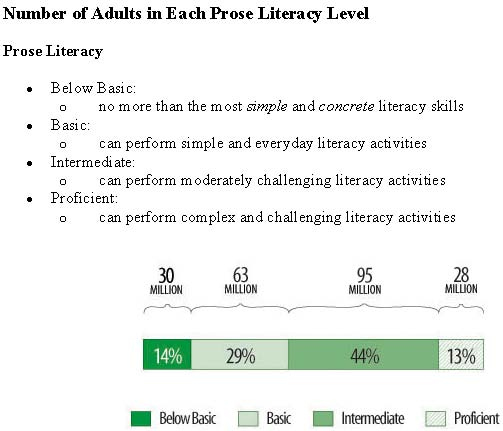
Of these:
- 55% are not high school graduates (compared to 15% in the general population)
- 44% spoke no English before starting school (compared to 13 % in the general population)
- 21% have multiple disabilities (compared to 9% in the general population)
Adults enrolled in ABE (adult basic education) programs read below the 7th grade level, on average. These adults are working toward earning a GED, which requires high school level reading. (Strucker and Davidson’s 2003 Adult Reading Components Study)
Adults in basic education classes require between 100 and 130 instructional hours to make one grade level of improvement. (John Comings, 2007. Review of Adult Learning and Literacy. Vol. 7., Ch. 2. Lawrence Erlbaum Associates, Inc., Mahwah, NJ.)
Most ABE students leave after just 30-80 hours of instruction with no tests passed. (Adult Education in America, 2007, C. Tamassia, M.Lennon, K.Yamamoto and I. Kirsh)
When Santa Fe Community College ABE students’ special learning needs are addressed, they demonstrated 50% higher post-test scores and attended 200% more hours on average than students without interventions. (PowerPath to Education and Employment, 2006, The TLP Group, Columbus, OH. Powerpath.com)
Since
- millions of adults with low literacy skills need to achieve life goals
- it takes a long time to raise their reading levels
- adults with “suspected learning disabilities” are seldom diagnosed…so they don’t qualify for accommodations
- they have immediate education, employment or other life needs
- learning and persistence improve when their special learning needs are addressed
- they have the capacity to learn but reading is the barrier….
– how can social innovations bridge that barrier?
Anne Murr is the Coordinator of the Adult Literacy Center at Drake University School of Education and Board Member with the National Association for Adults With Special Learning Needs.
Anne is a guest blogger in the guest blog discussion series on Social Innovations in Adult Education. See the full schedule online and participate by posting your comments in the box below.
