
 Loading ...
Blending Social and Technology Support for Digital Literacy
Date: August 22, 2011
—A Guest Blog Article in the Discussion Series on Social Innovations in Adult Education
Article by Stephen Reder
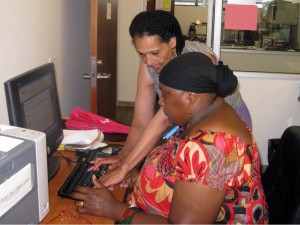
Where the rubber meets the road in the digital literacy project
When we talk about digital literacy, we’re often referring to a range of capabilities ranging from use of cutting-edge technologies at one end of a continuum to basic digital access and inclusion at the other end. As adult educators, we want to support our students’ movement along this continuum. There is good reason for us to be concerned. A recent survey by the U.S. Census found, for example, that although 65% of Americans use the internet at home, only 24% of adults without high school diplomas (or the equivalent) use internet at home.
When we look at digital literacy issues at the community level as well as at the individual level, the need for both social support and technology support becomes very clear. Adults who are not familiar or comfortable with technology cannot just be placed in front of computers—even computers with excellent digital literacy training materials. They need hands-on assistance from friends or family or community members: help getting started, help when they get stuck or want to try something new, and so forth.
I’d like to start this blog by mentioning a project being carried out by a network of dedicated adult educators experimenting with a new approach to increasing digital literacy in economically vulnerable populations: The Learner Web Partnership: A Multi-State Support System for Broadband Adoption by Digitally Marginalized Adults.
Their delivery model offers tutor-facilitated, self-paced learning in public computer centers. Carefully trained tutors—usually volunteers—are stationed in these computer centers, available to work with learners referred by adult education programs, libraries, community-based organizations, etc. This project is taking place initially in about 90 computer centers in five states: California, Minnesota, Louisiana, New York and Texas. With funding from a U.S. Department of Commerce BTOP (Broadband Technology Opportunities Program) grant, they are exploring variations on this tutor-facilitated self-directed learning model. Online content for adult learners and tutors who work with them is being developed by the Minnesota Literacy Council and ProLiteracy Worldwide for digital literacy, broadband consumer education and introduction to career pathways.
Although this tutor-facilitated self-access learning program has been operating for only four months thus far, a number of key points are emerging. I’ll mention two of these keys before opening the blog up to others. First, it is important that tutors and the learners they work with are all supported by the same technology, in this case the Learner Web. This creates the conditions for a shared learning support system in which those who assist adult learners are themselves learning with the same process as those they are assisting.
Second, it is essential that the learning plans that adults and their tutors follow are individualized with content customized to meet their individual needs. The content is presented in the learner’s preferred language and provides examples and points to resources (whether online or offline) from the adult’s local community. So learning how to do internet mapping involves destinations from the learner’s locale; learning how to use a search engine draws on personally meaningful topics such as finding a job, getting family health care information; and so forth. In these and other ways, the content presented is personally meaningful to learners.
Many of us have experience working with adults who are new to technology. I’m hoping we can share our experiences and insights in this blog about various ways that social support and online technologies can be effectively blended to facilitate digital literacy in the populations we serve.
Stephen Reder is the University Professor of Applied Linguistics at Portland State University.
Steve is is a guest blogger in the guest blog discussion series on Social Innovations in Adult Education. See the full schedule online and participate by posting your comments in the box below.
.
