
 Loading ...
Outlook on Funding for Adult Education and Family Literacy
Date: February 16, 2011

By Jackie Taylor
President’s Budget Proposal
On Monday, February 14, the President released his budget proposal for fiscal year 2012. “Within a constrained fiscal environment and a five-year freeze on discretionary spending, the budget proposes a $7.5 billion, 10.7% increase in overall discretionary spending for programs in the Department of Education ($2 billion (+4.3 percent) excluding Pell grants),” according to the Committee on Education Funding. While there are also many program reductions and eliminations in the budget, the Adult Education State Grants are funded at $635 million, $6.8 million over the FY2011 level.
A Workforce Innovation Fund, an 8% set-aside equivalent to $50.8 million, is designed to “provide grants for projects that encourage innovation and identify and validate effective strategies for improving the delivery of services and outcomes for all beneficiaries under the programs authorized by WIA, particularly those from the most vulnerable populations.” It would be administered with the Office of Special Education and Rehabilitative Services and in partnership with the Department of Labor.
However, much of the $50.8 million Workforce Innovation Fund is proposed to come from adult education state grants, which would result in a cut to these grants by $28.1 million, according to Art Ellison, Policy Chair with the National Council of State Directors of Adult Education. This would be about a 5% cut. But compare this to other education programs, such as the $1.0 billion request for Career and Technical Education (CTE) State Grants, which is $160.9 million below the 2011 continuing resolution annualized amount or a 13.9% cut. Adult education has fared better than many other education programs.
Further, he writes that it appears that a majority of the Workforce Innovation Grants will go back to the adult education field, specifically to “States or broad partnerships for implementing structural reforms and other approaches that deliver better employment and education results.”
From the Fiscal Year 2012 Budget Summary:
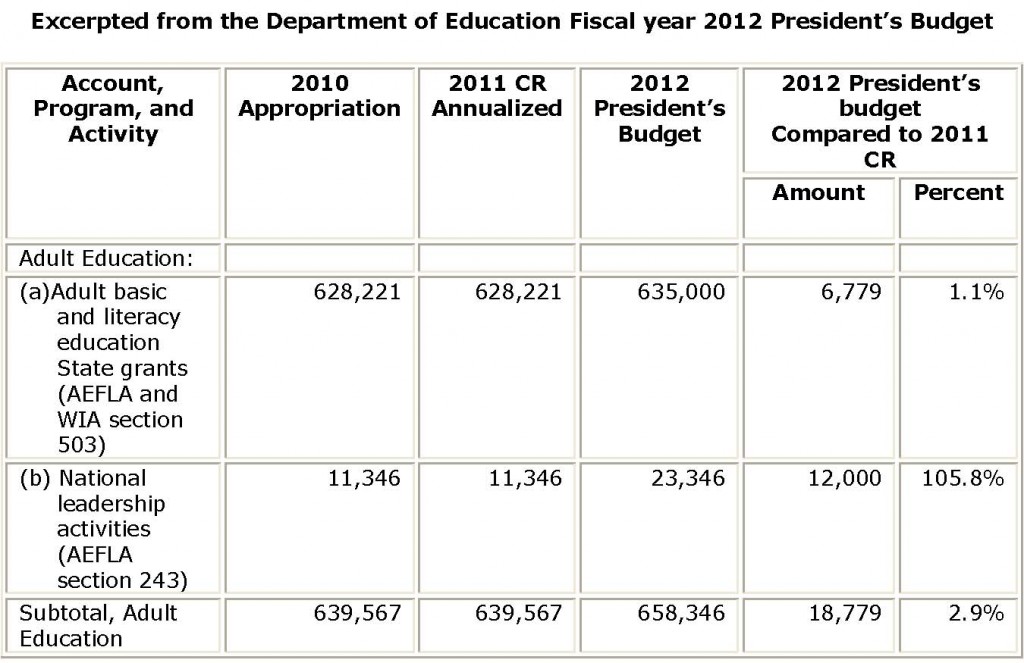
The request for Adult Education National Leadership Activities is $12.0 million over the 2011 CR level in the President’s proposed budget. “Of the $12.0 million increase, $6.0 million would support a new impact evaluation of “college bridge programs” that assist adult learners in transitioning from adult basic education to postsecondary education and training. The remaining $6.0 million would support the development of a comprehensive technology infrastructure for adult learners and practitioners. The balance of funds would provide continued support to the adult education and literacy field.”
EL/Civics would continue to be funded through a $75 million set-aside.
Even Start is among the programs proposed to be eliminated.
See the Fiscal Year 2012 Budget Summary for further details.
.
FY2011 Continuing Resolution
The year-long House CR was released Friday evening, February 11th to fund the government through FY11. It appears they are keeping FY2010 funding levels unless otherwise specified. Thus, adult education remains level funded from FY2010 since it is not mentioned. Even Start was zeroed out. The House has begun debates this week to finish funding fiscal year 2011 before a government shut down on March 4.
.
What does this mean for our message to Congress about funding?
Investing in adult education is a critical step to getting our nation well on the road to economic recovery and we are pleased with the President’s recognition of that. We applaud the President for recommending that Congress maintain overall funds for adult education. We also appreciate the Workforce Innovation Fund, funds set aside for system-wide, broad-based reform that can improve coordination and alignment between Title I and Title II and benefit the entire field.
We understand that tough decisions had to be made. Yet, it is disconcerting to be funded at $635M given the need and demand for adult education services and that the Administration proposes drawing the Workforce Innovation Fund from existing state grants.
But we must view this within a larger scope. Many other programs were significantly cut, frozen, or eliminated. The Administration has placed a priority on funding programs that are the most aligned with the President’s education reform agenda or that show evidence of strong performance. Adult education aligns with that agenda.
We are disappointed in the proposed elimination of Even Start and cutbacks in so many programs critical to children and families most in need. We do not wish to see support cut from those who struggle the most during times of economic hardship and stress.
However, we must continue to advance our concerns for the need and demand for adult education and family literacy services and its return on investment. This is where you come in. We’ll let you know soon how you can participate to protect and increase adult education funding for the betterment of adult and family literacy and the national priorities it impacts in our country.
Resources:
- President’s FY 2012 Budget Request for the U.S. Department of Education
- Budget proposal and justification for Career, Technical, and Adult Education
- Fact Sheets on Key Issues
