
 Loading ...
What Passage of the DREAM Act Means for Adult Education
Date: December 15, 2010
—A Public Policy Update on Adult Education and Literacy, Part III
By Jackie Taylor With Heidi Silver-Pacuilla and John Segota
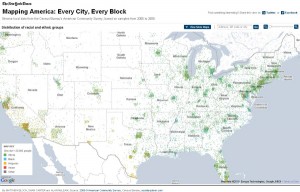
Click the map to browse local data from the Census Bureau's American Community Survey, courtesy of the New York Times
The DREAM Act was passed last week in the House and the Senate is expected to vote on it, with amendments, before the 111th Congress ends. The Migration Policy Institute has just released revised total and state-level estimates of the unauthorized youth and young adults who might be eligible for conditional legal status. Grassroots groups, like the National Council of LaRaza, the New Latino Movement, and many others, are making a last-minute effort to encourage the Senate to take up the vote in the lame duck session.
What follows is a short series of questions and answers for understanding the DREAM Act and what it means for adult ESL and adult education programs.
Will passage of the DREAM Act impact adult education and literacy programs?
The National Coalition for Literacy is monitoring the DREAM Act because if it becomes law, it would provide a significant incentive for as many as 1,355,000 young adults for whom English is not their first language and who lack a high school diploma to seek adult ESL instruction or attend adult education and GED classes.
What does the DREAM Act do?
According to thehill.com, “The DREAM Act offers a pathway to permanent residency — and eventually citizenship — for illegal immigrants brought to the U.S. as children if they meet certain requirements. They must have been in the country for at least five years; have earned a high school diploma, or its equivalent; and enter an institution of higher education or the military.” More than 1.9 million individuals could be eligible to apply for legal status under the legislation.
Given the serious, and in many cases, insurmountable barriers for many of these 1.9 million individuals to meet the bill’s education requirements, how many could we expect to gain permanent legal status?
According to the Migration Policy Institute (MPI) report DREAM vs. Reality: An Analysis of Potential DREAM Act Beneficiaries, roughly 38% of those who are eligible would likely obtain permanent legal status.
How many of those would become eligible beneficiaries if they earned a GED credential?
Young adults who do not have a high school diploma could become eligible for “conditional status” if they earn a GED credential, placing them on a path to legalization. Based on changes to the DREAM Act legislation pending in Congress, MPI has revised its earlier estimates published in July 2010. Those ages 18-29 without a high school diploma (421,000) and those eligible in the future if they obtain a high school diploma or its equivalent (934,000) could become eligible. See MPI’s revised totals below.
How will passage of the DREAM Act impact the demand for adult ESL instruction?
According to MPI, there will be an expected high demand for ESL instruction, especially for those with lower education attainment.
Does the DREAM Act increase the capacity of adult education programs to serve those who could become potential beneficiaries?
No. It would establish a pathway to citizenship for those that are eligible, but provides no resources to support any systems that would be impacted.
What states are expected to be impacted the most?
MPI estimates that the top ten states with the most potential beneficiaries would be: California, Texas, Florida, New York, Arizona, Illinois, New Jersey, Georgia, North Carolina, Virginia.
Revised total estimates provided courtesy of the Migration Policy Institute[i] :

See today’s press release from MPI to learn what’s changed in the DREAM Act as it pertains to MPI’s revised estimates of potential beneficiaries and for the complete listing of potential beneficiaries by state.
Share your comments and questions with us below.
Recent Public Policy Advocacy Updates:
December 14, 2010: Outlook on Adult Education Funding for Fiscal Year 2011
December 13, 2010: Jobs and the Economy–Reauthorizing the Workforce Investment Act
.
[1] MPI indicates that the revised numbers are not a line-by-line scoring of the House-passed bill now pending in the Senate. Rather, it revises the earlier numbers to take into account the lowered age cutoff. It also reflects that the House bill dropped the retroactivity provision in earlier versions of DREAM for immigrants 35 and older who already have at least an associate’s degree.
